A large measurement gap
Cognition is central to health, recovery, performance, and safety, but practical objective measurement is still limited.
Investors
RT-TRACE is RetinaTek's focused commercial product for objective longitudinal measurement in concussion care, supported by sponsored pilots, a staged FDA strategy, and a broader task-evoked neurocognitive platform.
Concussion recovery is followed through symptoms, brief tests, and clinician judgment, while practical objective longitudinal measurement remains limited. RetinaTek combines task-evoked eye tracking, manual responses, stimulus timing, and research-grade multimodal signals to build a repeatable measurement system for real clinical workflows.
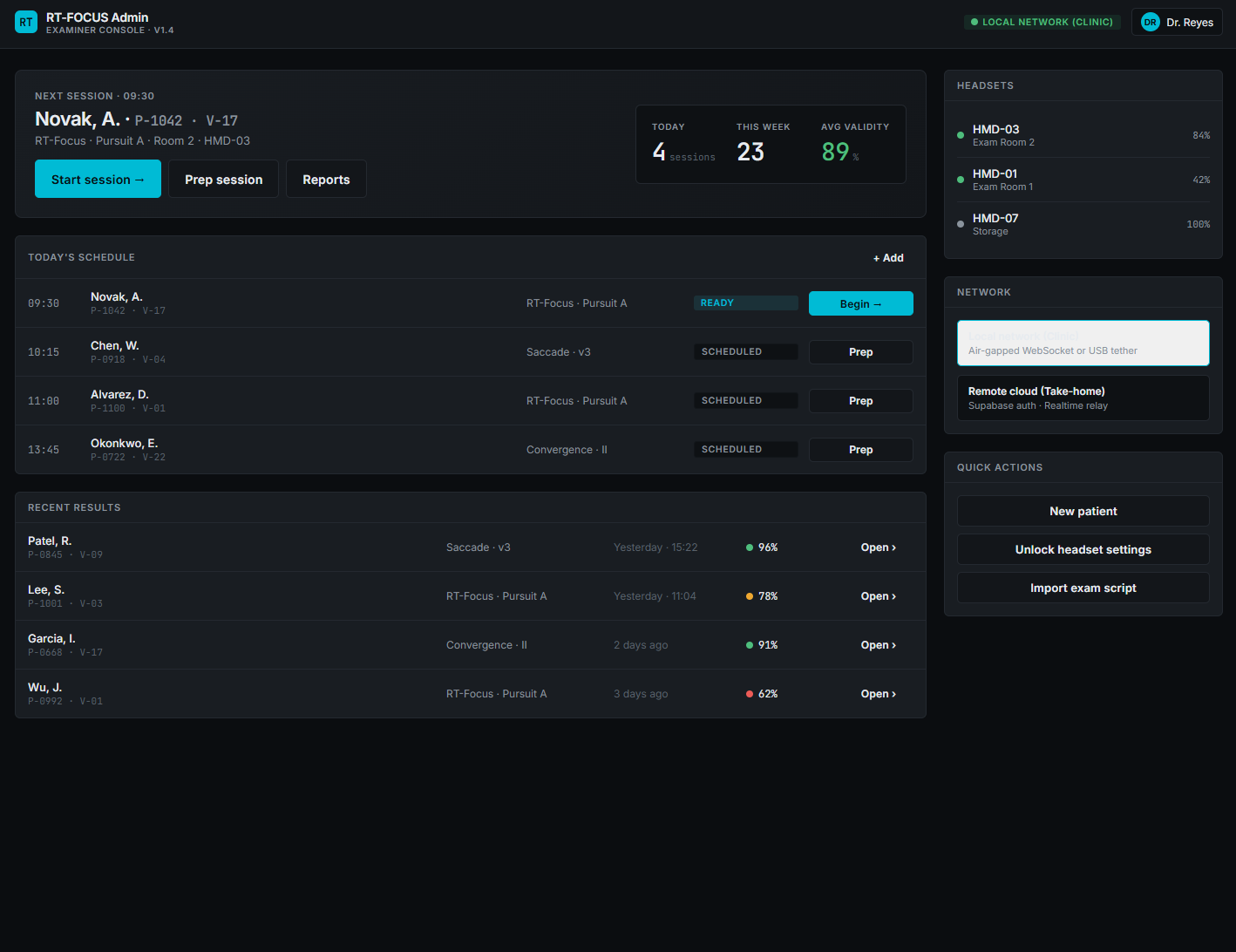
Cognition is central to health, recovery, performance, and safety, but practical objective measurement is still limited.
RETINA is task-evoked measurement, not passive gaze tracking or a digitized paper test.
RT-TRACE concentrates product development, evidence generation, and customer discovery on specialty concussion recovery programs.
Paid pilots build evidence now, RT-Focus is the planned first 510(k), and RT-TRACE follows through a condition-specific pathway after appropriate validation.
The same measurement architecture may extend into research endpoints, rehabilitation, cognitive aging, ADHD, MS, CNS trials, defense, occupational safety, and AI/data partnerships through appropriate research, validation, regulatory, and market-development pathways.
RT-TRACE focuses commercial development on specialty concussion programs, where repeatable objective recovery measurement addresses a clear workflow problem. Paid research systems and sponsor-funded observational pilots provide a near-term route to revenue, customer learning, and evidence generation without making clinical decision claims.
The regulatory sequence is deliberately narrower at first. RetinaTek has completed an FDA Q-Submission and plans RT-Focus as its first 510(k), establishing a general-assessment, quality, and regulatory foundation before pursuing condition-specific RT-TRACE claims.
Sponsored pilots generate traction. The staged pathway builds toward regulated scale.
Each stage has a distinct job: paid pilots test customer demand and workflow, RT-Focus establishes the first regulatory foundation, and RT-TRACE carries the focused condition-specific market opportunity.
Research systems and sponsor-funded observational pilots can generate revenue and product evidence before condition-specific clearance.
Sponsored pilots reveal what works in administration, reporting, training, support, workflow, and repeat testing.
Repeat assessments create experience with cognitive-performance measurement over time, which is central to future recovery-monitoring markets after appropriate validation and clearance.
Paid concussion-program deployments strengthen conversations with investors, strategic partners, researchers, and clinical-development collaborators.
Pilot use helps mature the software, data pipeline, quality controls, report design, and service model.
Paid pilot revenue and deployment evidence can reduce execution risk while future indications are validated.
Commercial headset hardware makes controlled, high-quality measurement increasingly deployable.
Specialty programs still rely heavily on symptoms, brief tests, and clinician judgment to follow recovery over time.
Concussion, sports medicine, neurology, and rehabilitation programs need objective measures that can fit repeat visits.
Biopharma and academic researchers need repeatable, low-burden digital endpoints for cognitive change and treatment response.
Concussion and mTBI research and clinical development need objective ways to study recovery trajectory, not just one-time assessment.
Future cognitive-state models need validated, task-evoked labels and longitudinal multimodal datasets.
The RetinaTek moat is not the headset. It is the patented task-evoked measurement approach, synchronized multimodal data architecture, scoring and quality-control layer, and evidence base linking these measures to cognitive, clinical, imaging, and performance outcomes.
Protected intellectual property around enhanced neuropsychological assessment using eye tracking and cognitive task paradigms.
Developed through more than a decade of federally supported military and clinical research.
Combines eye movements, pupil dynamics, manual responses, and stimulus timing into a unified measurement system.
Feature extraction, data-quality logic, score construction, and interpretation models remain proprietary.
Peer-reviewed research supports construct validity, cognitive-load sensitivity, performance-validity utility, and MRI-linked biological plausibility.
Repeated measurement across research and commercial deployments can create a differentiated dataset for future clinical and platform applications.
Diagnosis is important, but the larger future clinical-development opportunity is repeatable recovery-monitoring: helping determine whether a person is recovering as expected, plateauing, worsening, or likely to benefit from additional evaluation or intervention after appropriate validation and clearance.
RetinaTek is pursuing sponsored and grant-supported validation programs for adult and pediatric concussion/mTBI, with future expansion potential in ADHD, MS, neurodegenerative conditions, rehabilitation, and other CNS markets after appropriate validation and market development. Future clinical claims require appropriate validation and regulatory clearance.
RT-TRACE is the initial condition-specific focus for longitudinal recovery measurement after appropriate validation and clearance.
Potential future clinical-development applications where objective attention, inhibition, and consistency measures may add value.
Potential future clinical-development work involving processing speed, cognitive fatigue, treatment response, and disease-related cognitive change after appropriate validation.
Future applications may include rehabilitation, neurodegenerative conditions, Long COVID, medication effects, and CNS clinical trial endpoints.
Paid clinic- and sponsor-funded pilots that generate workflow, usability, and longitudinal evidence alongside usual care.
Paid research systems, endpoint-development studies, clinical-development collaborations, and sponsored validation work.
Potential per-assessment, subscription, or site-license models for cleared condition-specific use after appropriate validation and clearance.
Potential future opportunities in hardware integrations, CNS endpoints, longitudinal datasets, AI/data partnerships, and international markets.
New capital is intended to move RetinaTek from federally supported science to paid pilot traction, first-clearance execution, and RT-TRACE clinical-development readiness.
Apply completed FDA Q-Submission feedback to the first planned submission and its supporting quality and validation work.
Generate early revenue, workflow evidence, customer feedback, and longitudinal testing experience in concussion programs.
Expand studies and collaborations using objective neurocognitive endpoints.
Mature the platform architecture, reporting, data pipeline, security, and longitudinal measurement infrastructure.
Build documentation, usability, risk management, data integrity, and quality controls for future regulated development.
Translate completed Q-Submission feedback into RT-Focus submission planning and the later condition-specific RT-TRACE pathway.
Pursue NIH applications, SBIR submissions, and partner-supported validation programs for future concussion/mTBI recovery-monitoring indications.
RT-Focus 510(k) plan informed by completed FDA feedback
First paid RT-TRACE sponsored pilots under protocol
Research and clinical-development partnerships
NIH/SBIR submissions and potential awards
Product/software lock for future validation
Quality-system and validation readiness
Longitudinal dataset growth
Strategic platform partnership discussions
Adult and pediatric concussion/mTBI validation launch planning
RETINA is an in-development neurocognitive measurement platform. RetinaTek has completed an FDA Q-Submission and plans RT-Focus as its first 510(k) submission. RT-TRACE is investigational and is not FDA-cleared or FDA-approved for diagnosis, monitoring, treatment decisions, or return-to-activity decisions. Disease-specific claims require appropriate validation and regulatory clearance.
RetinaTek is engaging investors who understand medical devices, concussion care, digital health, CNS markets, and regulated software. The company is building sponsored pilot traction while pursuing the larger opportunity: objective, repeatable neurocognitive measurement across clinical and platform markets.