Controlled challenge
Structured tasks place specific demands on attention, inhibition, working memory, and response control.
Technology
RETINA turns commercial eye-tracking hardware into a cognitive measurement system by synchronizing controlled task events with eye movements, pupil dynamics, and manual responses.
Most eye-tracking systems measure where the eyes move. RETINA measures how the brain controls attention, speed, consistency, inhibition, and effort under controlled cognitive load. The result is a repeatable, multimodal assessment architecture designed to support research, cognitive-performance assessment, and future regulated clinical-development pathways.
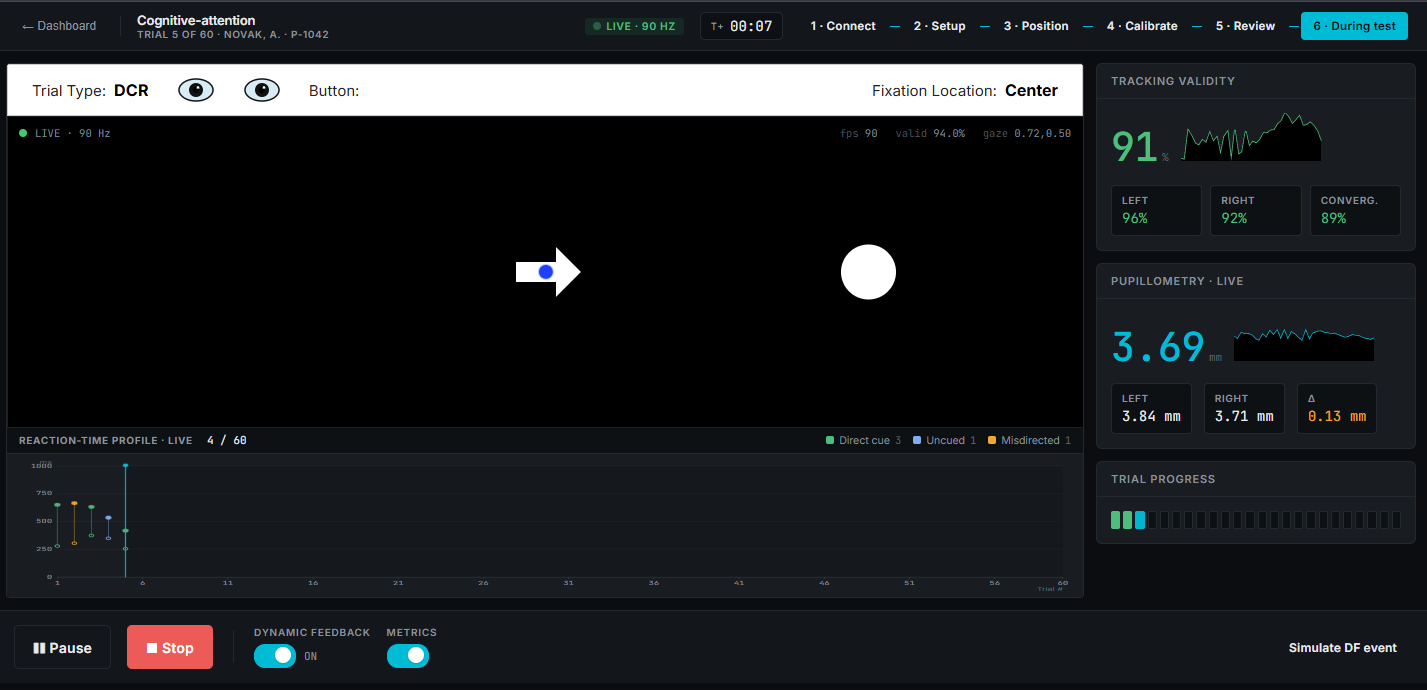
Eye movements become meaningful when they are interpreted in context. RETINA knows what the participant was asked to do, where the target appeared, when it appeared, what competing cue or cognitive demand was present, and how the participant responded.
That task context allows RetinaTek to move beyond passive gaze tracking and quantify performance patterns linked to attention, processing speed, cognitive control, consistency, and effort.
Structured tasks place specific demands on attention, inhibition, working memory, and response control.
Task events are aligned with gaze behavior, pupil dynamics, and manual responses.
Proprietary analysis converts performance patterns into practical research outputs such as Speed, Cognitive Control, and performance consistency.
RETINA does not rely on a single behavioral measure. It captures complementary signals while the participant completes controlled cognitive tasks. Eye and manual responses support the core performance assessment; pupil dynamics remain a research and sponsored-pilot capability for later evidence development.
Measure how quickly, consistently, and accurately the eyes respond to task-relevant information.
Captured in research and sponsored-pilot settings to study cognitive effort and task engagement. Pupillometry is not a delivered metric of the planned first cleared product.
Capture overt task performance and response timing, allowing comparison between eye-based and hand-based performance channels.
Anchors each response to the task event that produced it, allowing performance to be interpreted in cognitive context rather than as raw movement alone.
Automated quality checks help ensure that outputs are based on usable, interpretable task behavior and sensor data.
Commercial eye tracking is increasingly available. Validated neurocognitive measurement is not.
RETINA converts synchronized multimodal performance patterns into practical outputs designed to support cognitive-performance measurement, research endpoints, longitudinal studies, and future clinical-development pathways.
A research view of performance across controlled cognitive demand.
A measure of how efficiently the participant responds to task-relevant information.
A measure of consistency, inhibition, and control under competing demands.
Physiological and behavioral research measures related to task engagement and mental effort.
RetinaTek uses VR/XR hardware not because the product is a VR experience, but because head-mounted displays create a controlled, repeatable measurement environment for eye-tracking-based cognitive assessment.
The headset reduces room-level distractions and creates a standardized visual field.
Eye-tracking cameras positioned close to the eyes can support high-quality gaze and pupil measurement.
Consistent stimulus presentation and measurement conditions support longitudinal comparison over time.
Commercial headsets can reduce hardware cost and allow deployment outside specialized research labs.
RetinaTek's long-term architecture is designed to support hardware evolution rather than dependence on a single device.
The RetinaTek moat is not the headset. It is the patented, task-evoked measurement approach; the synchronized multimodal data architecture; the scoring and quality-control layer; and the scientific validation linking these measures to cognitive, clinical, imaging, and performance outcomes.
Protected intellectual property around enhanced neuropsychological assessment using eye tracking and cognitive task paradigms.
Developed through more than a decade of federally supported military and clinical research.
Combines eye movements, pupil dynamics, manual responses, and stimulus timing into a unified measurement system.
Designed to produce interpretable research outputs from task-evoked, synchronized performance signals.
RetinaTek's exact feature extraction, scoring methods, data-quality logic, and interpretation models remain proprietary.
RETINA's task-evoked architecture supports paid research and observational pilots today, the planned first RT-Focus clearance, and later condition-specific development of RT-TRACE for concussion recovery.